
The Human Standards Framework™
At the heart of all our work
At Futurise Edu, everything we design begins with one core belief:
In a world shaped by AI, education must become more deeply human.
The question is no longer only what students know.
It is also who they are becoming.
As technology grows more powerful, students need more than academic content. They need the human capacities that help them think clearly, relate to others, communicate with purpose, grow through challenge, and use powerful tools without giving away ownership of their thinking.
That is why we created the Human Standards Framework™.
It is the foundation beneath all of our work — our learning labs, school partnerships, professional development, resources, and assessment frameworks.
What is the Human Standards Framework?
The Human Standards Framework™ is a future-ready framework built around:
10 Universal Human Standards™
4 Human Domains™
1 Throughline
It is designed to help educators and students focus on the skills, habits, and dispositions that matter most in an AI-shaped world.
This framework does not replace academic standards.
It strengthens them by naming the human capacities students need in order to use knowledge wisely, act intentionally, and continue learning in a changing world.
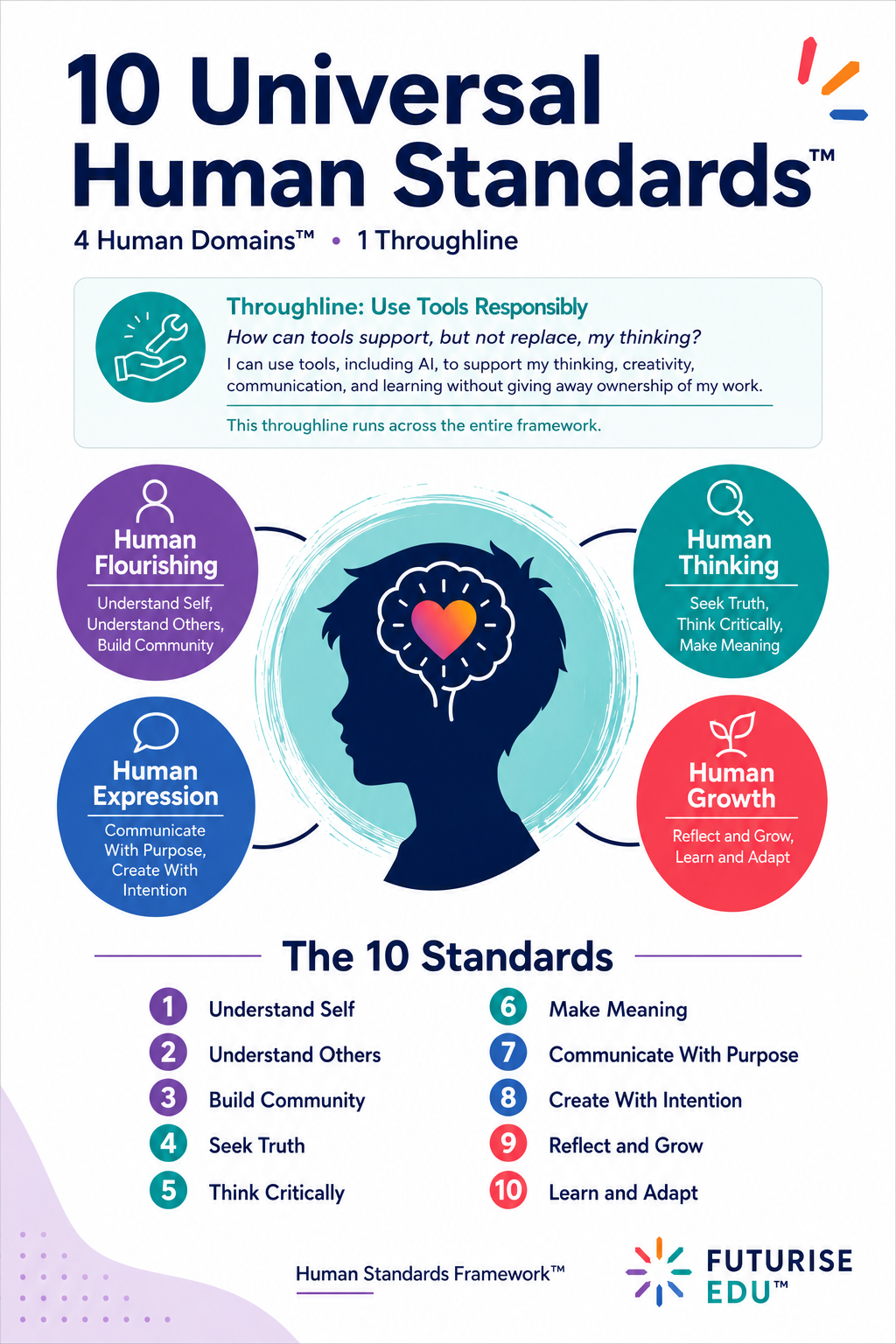
4 Human Domains™ • 1 Throughline
Throughline: Use Tools Responsibly
Core question:
How can tools support, but not replace, my thinking?
Students are growing up in a world full of powerful tools, including AI. They need to learn how to use those tools to support their thinking, creativity, communication, and learning — without giving away ownership of their work.
Student statement:
I can use tools, including AI, to support my thinking, creativity, communication, and learning without giving away ownership of my work.
This throughline runs across the entire framework.
The 4 Human Domains™
Human Flourishing
Human flourishing is about how students understand themselves, understand others, and contribute to the communities around them.
This domain includes:
Understand Self
Understand Others
Build Community
These standards help students grow in self-awareness, empathy, belonging, and responsibility.
Human Thinking
Human thinking is about how students make sense of information, evaluate what is true, and think deeply about the world.
This domain includes:
Seek Truth
Think Critically
Make Meaning
These standards help students question, analyze, interpret, and develop independent judgment.
Human Expression
Human expression is about how students communicate ideas and create with clarity, purpose, and intention.
This domain includes:
Communicate With Purpose
Create With Intention
These standards help students use their voice, design thoughtfully, and create work that matters.
Human Growth
Human growth is about how students reflect, learn, and adapt over time.
This domain includes:
Reflect and Grow
Learn and Adapt
These standards help students build resilience, curiosity, reflection, and lifelong learning habits.
The 10 Universal Human Standards™
1. Understand Self
Students develop awareness of who they are as learners and people. They notice their strengths, needs, emotions, habits, and choices.
2. Understand Others
Students learn to listen, notice, and consider perspectives beyond their own so they can better understand other people.
3. Build Community
Students learn how to contribute to groups, include others, repair harm, and take responsibility for the communities they are part of.
4. Seek Truth
Students learn to ask questions, evaluate information, consider evidence, and notice what may be missing.
5. Think Critically
Students learn to analyze ideas, question assumptions, connect information, and explain their reasoning.
6. Make Meaning
Students learn to connect ideas, interpret experiences, and understand why learning matters.
7. Communicate With Purpose
Students learn to communicate with audience, intention, and clarity across different contexts and formats.
8. Create With Intention
Students learn to design, make, and produce work thoughtfully, with purpose and care.
9. Reflect and Grow
Students learn to look back on their work, learn from feedback, and identify next steps for growth.
10. Learn and Adapt
Students learn to stay curious, respond to change, and continue learning in new situations.
Why this framework matters now
Too often, schools focus only on what students produce.
But in an AI-shaped world, the final product is no longer enough.
Students need support in developing the habits of mind and human capacities that cannot simply be outsourced:
self-awareness, empathy, judgment, meaning-making, communication, creativity, reflection, and adaptability.
These are not extra skills.
They are essential skills.
The Human Standards Framework helps schools bring those capacities into clearer focus so they can be taught, practiced, and embedded into everyday learning.
How we use the framework
The Human Standards Framework is not just a set of ideas. It is a design tool.
We use it to shape:
Learning labs that build human-centered, future-ready skills
School partnerships focused on authentic learning, AI literacy, and assessment design
Professional development that helps educators redesign learning for an AI-shaped world
Frameworks and resources that give schools practical tools for implementation
It helps us ask:
What does this learning experience make visible?
What human capacities are students practicing?
Where are students making meaning, communicating, reflecting, and growing?
How are they using tools responsibly without outsourcing their thinking?
Our belief
Technology will keep evolving.
But the need for human judgment, human connection, human expression, and human growth will only become more important.
That is why the Human Standards Framework™ is at the heart of all our work.
Because the future of learning should not become less human.
It should become more human.